Forthcoming by Asemana Books (April 2026)
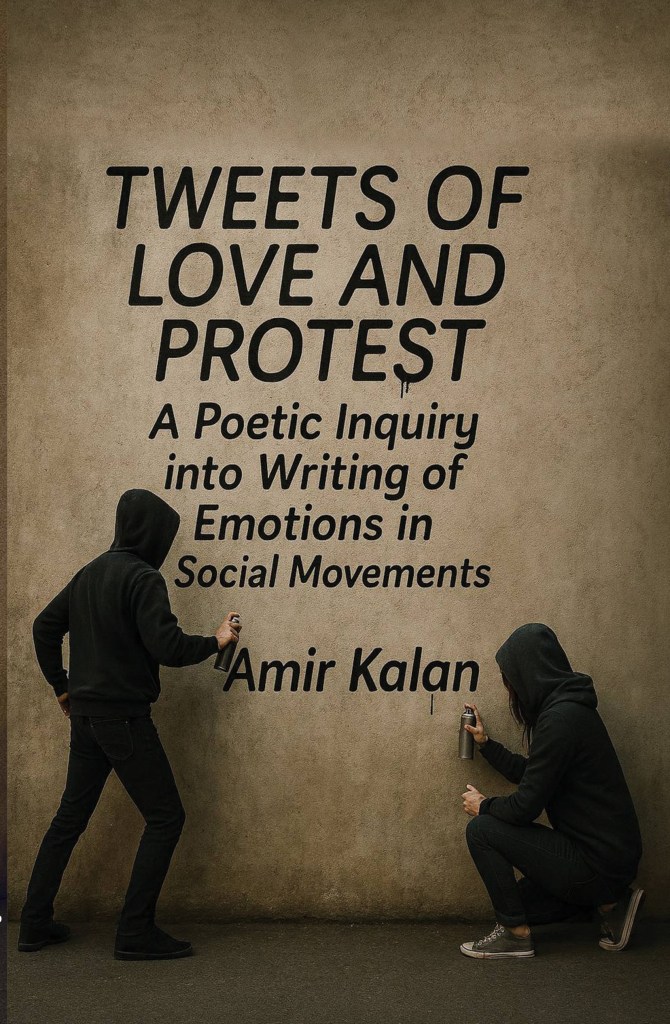
Tweets of Love and Protest
A Poetic Inquiry into Writing of Emotions in Social Movements
By
Amir Kalan
ISBN: 978-1-997503-38-5
Part of Amir Kalan’s larger Writing in Times of Crisis project, this book offers an innovative arts‑based exploration of a pool of Iranian protest tweets, transforming them through a new methodological approach he calls Refractive Poetic Analysis—a form of poetic inquiry between found and generated poetry. Blending insights from sociology, political science, communication, cultural studies, and writing studies, the work reframes emotionally charged digital traces as poetic artifacts that illuminate the affective landscapes of resistance. The volume weaves together a curated sequence of short poems with a reflective methodological chapter, illustrating how poetry can function not only as representation but also as analysis, revealing the collective emotional textures often obscured by platform algorithms. In doing so, the book positions the algorithmically isolated spaces of social media as vital archives and contributes to research‑creation practices that seek to surface subaltern voices and challenge dominant political narratives.

Amir Kalan
Amir Kalan is Assistant Professor in the Department of Integrated Studies in Education (DISE) at McGill University. His research interests include critical literacy, multiliteracies, second language writing, intercultural rhetoric, multilingual text generation, and multimodal and digital writing. In his research, he mobilizes mainstream qualitative research and alternative qualitative methods such as narrative inquiry, autoethnography, and visual ethnography to study sociocultural, discursive, political, and power relational contexts of literacy engagement. He is particularly interested in learning from the experiences of minoritized and racialized students in multicultural and multilingual contexts and from non-Western forms of language and literacy education.
 Asemana Books